
Inferno
Dan Brown’s 2013 book 4 of 6 in Robert Langdon with a 17-hour-12-minute audiobook: Inferno is the fourth Robert Langdon novel, first published in Britain by Bantam Press in 2013. Langdon wakes in a Florence hospital with missing memories and encounters a mystery connected with Dante; suggested age: 16+ · editorial guidance — suicide imagery; disturbing visions of death.
- Series reading position
- Book 4 of 6 · Robert Langdon
- UK first published
- 2013 · Bantam Press
- Suggested age
- 16+ · editorial guidance
- Audiobook narrator
- Paul Michael
The story without spoilers
Robert Langdon wakes in a hospital in Florence with no memory of how he arrived there. A strange object in his belongings and a threat to his life turn that medical beginning into an urgent investigation. Sienna Brooks, a young doctor, accompanies him as clues connected with Dante’s Inferno draw on the city’s historic surroundings. The publisher’s description names the hospital, missing memories, doctor and literary connection.
The immediate puzzle differs from an invitation to give a lecture or examine a museum crime scene: the professor first has to orient himself in unfamiliar circumstances. His knowledge of symbols remains part of the premise, while the title identifies a particular work of literature as its cultural starting point. Florence’s art and architecture surround a problem involving a contemporary threat. The official introduction pairs that historic material with modern science and Langdon’s academic expertise.
Can I start here?
Inferno is Robert Langdon novel four, following The Lost Symbol. For the full publication sequence, start with Angels & Demons, then The Da Vinci Code and The Lost Symbol before reaching this one. The numbered publisher list places Origin next and The Secret of Secrets sixth. A reader selecting by subject has a distinct reason to choose this entry: its stated invitation is Florence and Dante, rather than Rome, Paris or Washington.
Last checked October 2026
The book’s literary reference is Dante Alighieri’s medieval poem, whose Inferno is the first part of The Divine Comedy. A publisher’s introduction to Dante identifies Virgil as the guide through its underworld. Familiarity with that poem can supply an additional literary interest, while Brown’s own blurb introduces the relevant title at the beginning. The starting routes also include options for readers coming from the 2016 film or choosing a narrator first.
What stands out
A 2013 novel prepared for several languages
The first British edition appeared under Bantam Press in 2013. The current paperback’s copyright page dates the Corgi edition to 2014 and its reissue to 2025. The UK digital text has a publication date of 14 May 2013 and ISBN 9781448169795. These distinguish the original launch from the later paperback used for this guide.
The international preparation had its own documented publishing story. On 7 May 2013, the author’s news page linked a Mondadori behind-the-scenes trailer showing the secure workspace where translations were being prepared in German, Portuguese, French, Spanish, Catalan and Italian. The announcement identifies specific language editions being worked on ahead of release, rather than a cumulative worldwide translation total. It provides a concrete glimpse of the coordinated work behind an international thriller launch.
A title borrowed from a particular literary work
Dante’s Divine Comedy comprises Inferno, Purgatorio and Paradiso. The first part places Dante on a journey through Hell with Virgil as his guide. A complete edition’s description distinguishes the three parts, while the separate Hell edition describes the nine circles of the underworld. The reference is therefore to a defined part of a longer poem, with its own guide, geography and tradition of illustrated editions.
Brown’s book also received a special illustrated edition. A dated announcement on 11 November 2014 describes more than 200 colour images. That publication belongs to the book’s history as a text concerned with visual culture. It is a different presentation from the current Corgi paperback: the announcement’s image count concerns the illustrated edition specifically.
A first setting with identifiable Florentine buildings
The official prologue names the River Arno, the Uffizi, the Bargello and the Badia. These are opening-page geographical references. The Uffizi occupies a building designed by Giorgio Vasari and constructed between 1560 and 1580; its gallery uses the first and second floors. The museum’s history identifies collections of ancient sculpture and paintings ranging from medieval to modern periods, including a particularly strong Renaissance collection.
The Badia Fiorentina is the city’s oldest Benedictine monastery, founded in 978 by Willa, mother of Marquis Ugo of Tuscany. Its church was substantially altered by Arnolfo di Cambio in 1285, and the Cloister of the Oranges dates from around 1435. These dates come from Florence’s municipal visitor information. The mixture of medieval foundations and later architectural layers belongs to the real streetscape surrounding the opening.
Real places in the novel
The Uffizi is Florence’s major painting and sculpture gallery, named in the prologue; the official visitor page lists Tuesday-to-Sunday opening and Monday closure. The Bargello, also named there, is a museum whose official booking page starts with selecting a visit date.
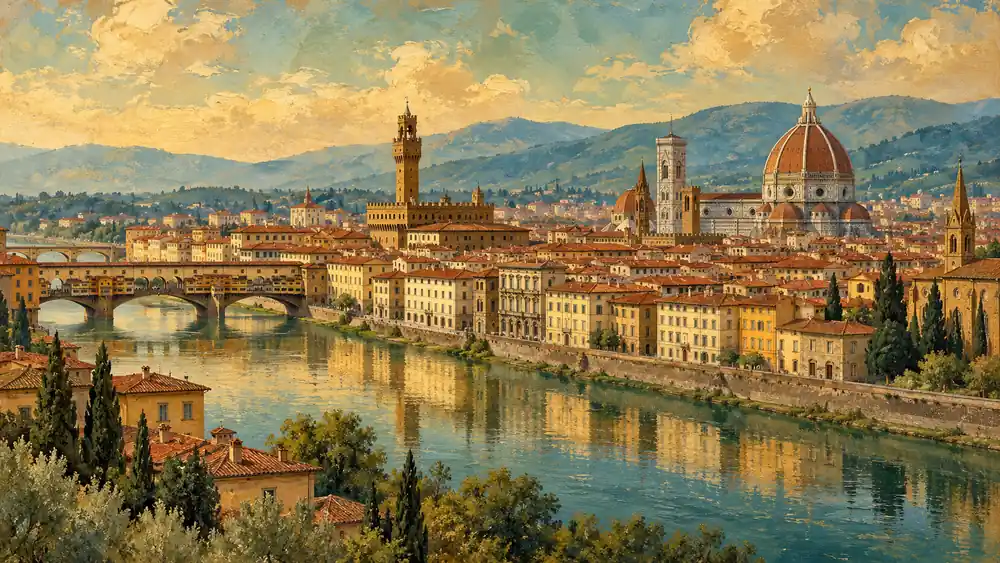
The Badia Fiorentina is the historic monastery and church near the Bargello. Its municipal listing gives the address as Via del Proconsolo and lists Sunday closure; the Arno is the river named at the prologue’s beginning. The city’s official visitor service provides information for planning a walk through the historic centre. Visitor details checked October 2026.
Content notes and suggested age
Suggested age: 16+; editorial guidance for an adult thriller. The opening excerpt includes suicide imagery, disturbing visions of death and medical disorientation. The published premise adds threats to life and pursuit. The treatment of religious imagery and physical danger makes the nature of the opening more useful for a family reading decision than the mere presence of a famous poem. Readers sensitive to medical settings, frightening bodily images or suicide references should consider those themes before choosing it.
Book and screen
Last checked October 2026
Released: Inferno became the third Robert Langdon feature film in 2016. Tom Hanks returned as Langdon, with Felicity Jones as Sienna Brooks. The studio’s film page identifies those roles and the 2016 production. This was the third released Hanks film, although the source novel occupies the fourth position in the literary sequence.
Ron Howard directed, David Koepp wrote the screenplay, and Brian Grazer and Howard produced. Principal photography had begun by the studio announcement of 11 May 2015. The announced cast included Irrfan Khan, Omar Sy, Ben Foster and Sidse Babett Knudsen; executive producers included Dan Brown, Anna Culp, David Householter and William M. Connor. Salvatore Totino was director of photography and Peter Wenham production designer. The adaptation guide places this production alongside the earlier films and later television projects.
Main characters
Robert Langdon is the Harvard symbologist waking in a Florence hospital with missing memories. Sienna Brooks is the young doctor who joins him as danger develops. Their initial professional roles, the medical setting and the literary clues are established by the UK blurb. The opening places a doctor and a humanities academic together, with his memory loss providing an immediate obstacle to understanding his own circumstances.
Publication and editions
Retailer links may earn us a small commission at no extra cost to you.
The selected paperback is ISBN 9780552169585, Corgi, dated 3 July 2025 and listed at 624 pages. The edition details identify Robert Langdon book four. The 2013 ebook belongs to the Transworld Digital imprint. This reissue follows the 2013 British Bantam Press original and 2014 Corgi paperback; its date identifies the edition linked here.
The selected Audible UK recording is narrated by Paul Michael. The series catalogue gives 17 hours 12 minutes, unabridged, with a release date of 14 May 2013. The copyright credits identify Dan Brown’s 2013 text and Penguin Audio’s 2013 recording. The exact recording link distinguishes it from other editions bearing the same title.
Is it worth reading?
Our verdict: select Inferno for the Florence opening and its connection between Dante’s poetry, Renaissance surroundings and an immediate medical mystery. Readers following Langdon in order can arrive from The Lost Symbol and continue to Origin’s Bilbao beginning.
Buy or listen
Retailer links may earn us a small commission at no extra cost to you.
Listen on AudibleBuy from AmazonAs an Amazon Associate we earn from qualifying purchases.
Paperback · ISBN 9780552169585
Audio · Paul Michael · 17 hours 12 minutes
Check the edition before buying.
Where next



Sources
Retailer links may earn us a small commission at no extra cost to you.
- Penguin UK: Inferno (ISBN 9780552169585)
- Dan Brown official site: Inferno
- Penguin UK: Dan Brown’s Robert Langdon books in order
- Penguin UK: Inferno — The Comedy of Dante Alighieri (ISBN 9780140440065)
- Penguin UK: Inferno opening extract (PDF) (ISBN 9780552169585)
- Penguin UK: Inferno (ISBN 9781448169795)
- Dan Brown official site: Mondadori’s trailer for Inferno: Inside the Book
- Penguin UK: Inferno — The Divine Comedy (ISBN 9781857151831)
- Dan Brown official site: The Special Illustrated Edition of Inferno has Arrived
- Uffizi Galleries: Inferno — The Uffizi
- Feel Florence (official Florence tourism): Inferno — Badia Fiorentina (Santa Maria Assunta)
- Musei del Bargello: Inferno — Tickets
- Feel Florence (official Florence tourism): Inferno — Florence visitor information
- Sony Pictures: Inferno (2016) film page
- Sony Pictures: Principal photography begins on Inferno, starring Tom Hanks and directed by Ron Howard
- Audible UK: Inferno
- Audible UK: Robert Langdon series page (audiobook series)
