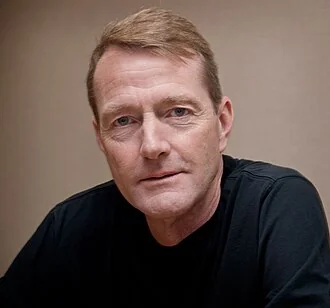
Lee Child · Crime & Thrillers An imaginary book festival
Lee Child: the Jack Reacher tent
Lee Child introduced Jack Reacher in Killing Floor in 1997. Start with the first-person Margrave case, or follow the book behind the television investigation you have just finished.
Killing Floor is the best place to begin Jack Reacher: it introduces the former military policeman through a murder accusation in Margrave, Georgia, and it is told in his own voice. Lee Child’s 1997 debut became the source of the first Reacher television season.
The book guide follows that particular connection, including the first-person narration and the addition of Frances Neagley on screen. Beginning here gives a viewer the familiar town but a different way into the investigator’s thinking.
The choice is between reading the original beginning and returning to the specific investigation that caught your attention.
Who is Lee Child?
Last checked October 2026
Lee Child was born in Coventry in 1954 and grew up in Birmingham. Before Reacher, he studied law in Sheffield and worked as a presentation director at Granada Television in Manchester. His eighteen-year television career ended with corporate restructuring in 1995. Killing Floor became his route into a new career.
The move into fiction was a change of occupation for a television professional, rather than the next instalment from an established novelist.
The debut involved Child’s agent Darley Anderson and the people at Transworld who would help bring the book to British readers. Child wrote the opening in Cumbria while aiming for an American readership. The manuscript was acquired in the United States by Putnam before its British acquisition.
That route matters to the books’ identity: a British writer’s first published hero is a displaced American military policeman, moving through American places rather than solving cases from a British base.
Killing Floor’s early reception included the 1998 Anthony Award for Best First Novel. The debut also won the Barry award for first mystery fiction. The debut’s reputation therefore predates either screen Reacher. Those are awards for the beginning of the writing career, distinct from later publicity attached to the long-running series and its adaptations.
That mobility is a structural freedom for the series: another novel can introduce another town without having to explain why a local detective has abandoned his usual patch.
The voice outside Reacher is a deliberate part of the series’ range, rather than a different hero. Reading Killing Floor beside Persuader therefore brings together two first-person investigations separated by five third-person novels: the Margrave arrival and the later undercover case put the reader back inside the same investigator’s account.
The distinction also makes the first novel worth reading after television, which must communicate much of that thinking through performance.
How many Jack Reacher books are there?
There are 31 numbered novels through Chain Reaction, published in the UK on 20 October 2026. The thirty-first novel continues the numbering begun in 1997. Killing Floor is number one; No Middle Name does not occupy a place in that novel sequence.
The publication-order list keeps the novels numbered and places shorter publications alongside them, making it possible to continue the sequence without mistaking a collection for the next novel.
It is a distinctly different contemporary setup from the new arrival and local murder accusation in Killing Floor, even though the series still relies on an outsider becoming involved in somebody else’s trouble.
That history gives the partnership a concrete connection to the debut, rather than making the shared surname the only explanation for the handover of work.
Andrew’s earlier career also included fiction under his own established name: his thrillers include Even, Die Twice, False Positive and Invisible. The Sentinel is therefore a collaboration between two published writers. Later novel jackets continue to credit Lee Child and Andrew Child, including Chain Reaction.
Those credits establish authorship as published; they do not identify which brother wrote an individual scene or sentence.
Three useful reading routes
1. Follow the novels as they appeared
Publication order starts with Killing Floor, Die Trying and Tripwire, then The Visitor, the UK title of the fourth novel. The fourth book’s US title is Running Blind, the title Child used when discussing its publication in America. These two titles identify one novel, not consecutive adventures.
The UK-title reading list avoids that easy double purchase and includes the two novels published in 2010, 61 Hours and Worth Dying For, in their sequence.
Following every publication and following that particular journey are therefore slightly different reading routes.
3. Go back to the military years
The Enemy opens on New Year’s Day 1990 with Reacher still an officer; The Affair begins in March 1997 with an undercover assignment near a Mississippi army base. Both were published after Killing Floor. Their earlier settings answer a different question from the debut: how Reacher operates while inside an institution, before the travelling life that introduces him to Margrave.
Putting them first produces a life-history arrangement; leaving them in publication order preserves the sequence in which readers originally discovered those periods.
Reacher, Roscoe, Finlay and Neagley
Last checked October 2026
Killing Floor introduces Reacher to Margrave’s police through his arrest; Finlay questions him about his movements. That first encounter belongs to the police process, before the case becomes clear. Reacher brings investigative experience from the military, but he is the accused stranger here. The distinction between his competence and his lack of local authority supplies much of the early friction.
Frances Neagley is a different kind of connection: a former military colleague who belongs to Reacher’s past. Season one brings her in from outside Killing Floor, a decision made by showrunner Nick Santora. Maria Sten’s presence in the television version should therefore not send a reader searching the debut for a missing conversation.
The screen introduction builds a link to Reacher’s wider life earlier than that novel does.
Illustration: a bus on a snowbound Dakota road
Short fiction without double counting
No Middle Name contains twelve stories, including the novella Too Much Time. Its contents also include Second Son, Deep Down, High Heat, Not a Drill and Small Wars, which appeared as separate digital publications. The collection is one volume containing several adventures, not twelve extra novels.
Buying every earlier single as well repeats much of its contents; that is why the reading list separates story titles from numbered full-length entries.
Further collaborations pair Reacher with other series characters: Good and Valuable Consideration pairs Reacher with Joseph Finder’s Nick Heller; Faking a Murderer brings him together with Kathy Reichs’s Temperance Brennan; Cleaning the Gold pairs him with Karin Slaughter’s Will Trent. Those crossovers are separate choices from No Middle Name.
The short-fiction section identifies the publications rather than inflating the novel count with their later editions.
The practical choice is print ISBN or narrator and recording, while the reading sequence remains anchored to the novel’s first publication in 1997.
Awards and milestones
Lee Child received the Crime Writers’ Association’s Diamond Dagger in 2013, recognising his body of crime fiction. His 61 Hours also won the Theakstons Old Peculier Crime Writing Award in 2011, and A Wanted Man was named Crime Book of the Year at the 2012 Specsavers National Book Awards. These milestones sit within the Jack Reacher publishing sequence.
Killing Floor remains the first novel for readers who want to meet Reacher at the beginning. The combined list separates the novels from shorter works, while individual guides identify the selected print ISBN and audiobook. Choose a starting case, then compare its opening situation and adult content notes.