Begin with He Who Fights with Monsters book 1 and continue in numbered order. Jason Asano arrives in an unfamiliar world of magic and monsters, bringing the experience of an Australian retail worker into a life of adventuring. The series combines fantasy action with humour and the structured growth associated with LitRPG.
Heath Miller reads the English audiobooks, beginning with a 28-hour-56-minute recording released by Podium Audio in 2021.
For a first encounter, choose between a print opening and an audio sample. Print lets you pause over unfamiliar terms and return easily to descriptions of abilities. Audio gives those explanations a spoken pace.
The best initial test is whether the mixture of adventure, conversation and explicit rules interests you, since this is a continuing series with long volumes rather than a short standalone introduction.
Readers already familiar with the web serial can use the numbered book sequence to identify a collected volume. Readers coming from a newly titled UK print edition should keep its number beside its title: Outworlder is the first novel and Adventurer the second. A new edition presents an existing numbered story in a later format.
Follow the volume sequence when moving between formats.
The opening introduces a man confronting circumstances for which his previous employment has given him little preparation. That makes it accessible to someone new to the imagined world. The reading commitment grows from there. Try the first book before assembling a long shelf, and use the exact-edition details in each guide when deciding which format to borrow.
Questions readers ask: Where to start
Which Shirtaloon book should I read first?
Start Shirtaloon with He Who Fights with Monsters, volume one, for Jason Asano’s arrival in an unfamiliar magical world. His developing abilities introduce the progression-fantasy structure that continues through the later volumes. The first guide has 16+ editorial guidance, with graphic violence, gore and strong language among the stated content considerations; a game-system premise is not a children’s label.
Which Shirtaloon route is best for younger readers?
The first He Who Fights with Monsters guide gives 16+ editorial guidance, with graphic violence, gore and strong language among the tent’s stated content considerations. A game-system premise is a genre description rather than a child-suitability label. Check the selected volume’s notes and start with Jason’s arrival in book one before approaching the later sequel premises.
Where do I go after my first Shirtaloon book?
Continue He Who Fights with Monsters with volume two after finishing volume one, then follow the numbers through the thirteen volumes listed here. Jason’s abilities and relationships develop across that sequence. The selected Audible UK recordings use Heath Miller; check each volume’s duration when planning a long listen rather than skipping ahead because another recording is shorter.
What LitRPG means here
LitRPG brings role-playing-game structures into prose fiction. Character abilities, progression and the rules governing power can become explicit parts of how a story is told. In He Who Fights with Monsters, the fantasy adventure includes gaining powers and learning how a new world's systems operate.
Podium groups the series under LitRPG and GameLit, and describes its combination of cultivation and traditional LitRPG elements.
For a reader, the useful distinction is between enjoying an imagined world and enjoying explanations of how its powers work. A fantasy novel may contain magic while leaving much of its operation mysterious. A progression story can make the acquisition and development of abilities an attraction in its own right.
Consider whether you enjoy following a capability from introduction through practice, alongside the characters' immediate problems.
Gaming experience can provide familiar vocabulary, but the book is prose to read or hear. There are no controls to learn and no equipment to buy beyond the chosen reading format.
A newcomer can pay attention to what the rules allow a character to attempt, while a regular role-playing-game player may be interested in how a written adventure handles choice differently from a playable one.
A useful first-book discussion is the relationship between intention and ability. Jason wants to act heroically, yet his powers have an unsettling character. That advertised contrast gives the opening a question about how a person uses the means available to them.
It also provides a reason to try the series beyond an interest in statistics alone: the rules interact with social expectations and personal decisions.
Illustration: sunlight across an empty training courtyard
He Who Fights with Monsters in order
The published English audiobook sequence contains thirteen numbered novels through the release of book 13 on 6 October 2026. Read 1, 2 and 3 first, then continue through 4–13 in sequence. Later entries continue Jason's story and assume the earlier journey. Their individual guide pages give the appropriate sequel warning before describing a later opening.
Retailer links may earn us a small commission at no extra cost to you.
The numbered route is particularly useful when the same series appears under several forms of title. A subtitle such as A LitRPG Adventure describes the kind of book; a volume number identifies its position. A regional reissue title can supply another name for the same numbered novel.
Keep author, number and format together when arranging reservations across a library's print and audio catalogues.
Publication order also offers a straightforward way to return after a break. Find the last numbered book you completed before selecting the next one. A personal note about your place can be more reliable than remembering a cover, since editions and artwork change.
The individual guides link back to this sequence so that a reader arriving through a particular title has a route to the beginning.
Questions readers ask: Reading order
Do I need to read Shirtaloon’s series in order?
He Who Fights with Monsters follows Jason Asano through a continuing progression-fantasy story, so begin at volume one and keep to the numbered sequence. The thirteen volumes in this tent are successive books, not thirteen unrelated fantasy introductions. Their game-like abilities and growing systems form part of that continuing structure, alongside the characters and events carried between volumes.
How many Shirtaloon books are there?
There are 13 numbered He Who Fights with Monsters novels in this guide. They follow Jason Asano through one continuing progression-fantasy sequence, starting with his arrival in an unfamiliar world. The volume numbers identify the reading order; a hardcover reissue or another audio edition of an existing number does not create an additional episode in Jason’s story.
What is the newest Shirtaloon book?
He Who Fights with Monsters 13 is the latest numbered volume here, released in English audio on 6 October 2026. That is the publication scope recorded for this edition, not an inferred UK first-print date. It follows volume 12 and belongs late in Jason’s continuing story; start at volume one if you are new to the series.
From web serial to collected novels
He Who Fights with Monsters began as an online serial on Royal Road before its collected audio editions. The author still links to Royal Road from the official website. Podium's first-volume introduction identifies that serial background, connecting the books with a form in which readers originally followed an ongoing work in instalments.
A serial and a collected book offer different reading rhythms. Instalments create natural pauses between visits; a complete volume lets a reader continue immediately. Someone who enjoys reading a little each evening may preserve the sense of smaller stages, while an audiobook listener may spend a longer journey with the same world.
Plan the long recording in sessions that fit your time and attention.
When changing from serial reading to a collected edition, identify the numbered volume through the official book sequence. A chapter remembered from an online platform and an audiobook's track number are different reference systems. Use the volume itself as the shared point when discussing a read with somebody using another format.
Chapter and page references can then be checked within the copies actually being used.
The serial origin is also relevant to the decision between one book and a long-term series project. The first arrival provides an introduction, but the series continues well beyond it. Someone wanting a single brief fantasy story may prefer another reading plan. Someone wanting repeated visits to an unfolding world has a concrete reason to investigate this sequence.
Illustration: lanterns above a dusky mountain valley
The published author introduction
Shirtaloon is the pen name used by Travis Deverell, who identifies that name openly on the official author website. The published Penguin biography describes a change from working on an academic paper to writing an interdimensional fantasy adventure, followed by finding an audience in online serial fiction.
That public introduction is enough to place the writing route from online readership to books.
The author's own site offers series links and a route to the original online platforms. For readers deciding where to begin, those connections are more useful than personal speculation. The relevant creative identity here is the name under which the stories are published.
A catalogue may display both the pen name and the openly credited name, so use the book title and number alongside either when searching.
This tent presents the work through its reading choices: the first premise, the ordered novels, audio performance and selected editions. A book group can use the published biography to discuss the move between writing forms, then concentrate on how the opening communicates its imagined world. No photograph is needed to understand that route or to make a reading decision.
Content notes and age guidance
Contains graphic violence, gore, strong language, threats and sustained fantasy combat. The first book's advertised dangers include cannibals, cultists and monsters. Suggested age: 16+ (editorial). The humour and game-like systems accompany adult violence and the individual content notes.
For a teenager, consider comfort with detailed violent fantasy as well as enthusiasm for role-playing games. A reader may enjoy planning character abilities while disliking the physical consequences of combat. Another may enjoy long fantasy novels but have little interest in explicit progression.
Those are separate selection questions, and a sample gives a more concrete starting point than a general genre recommendation.
For listening in shared spaces, take the strong language and violent material into account before choosing it as a family car recording. Headphones can change who hears a performance, but they do not change its content. Discuss the subject guidance with the intended listener and let them choose another book if the mixture sounds uncomfortable.
The numbered series continues through changing circumstances and escalating fantasy stakes. Follow the note on the particular volume when deciding whether to continue. Age guidance is an editorial judgement, not a publisher-issued classification or a guarantee that every reader of that age will respond in the same way.
Characters: the opening role
Jason Asano is the Australian retail worker who arrives in a world of magic and monsters. His introductory problem is learning to survive somewhere unfamiliar. The former job and the new circumstances provide a direct contrast: habits from ordinary working life meet the practical demands of adventuring.
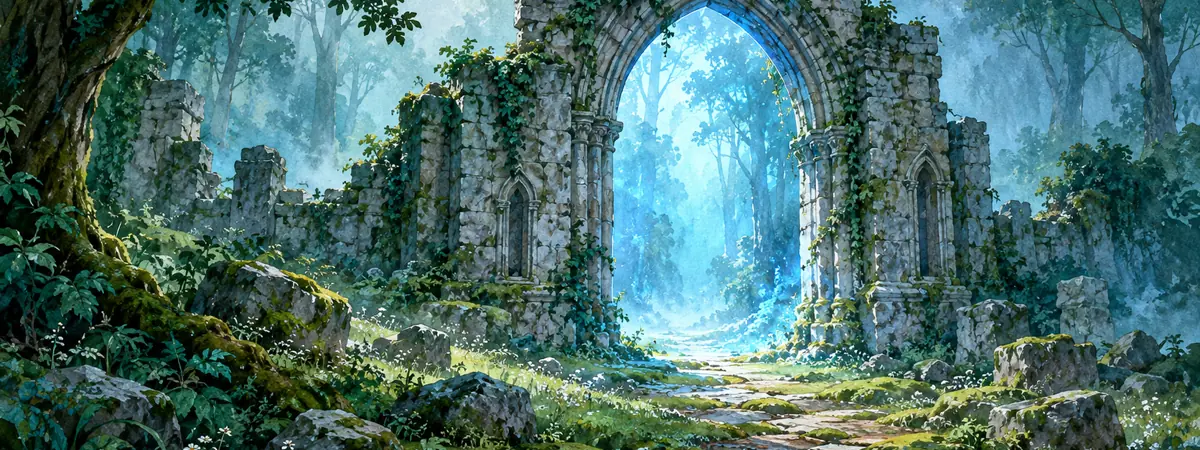
An empty doorway or portal is the emblem for that starting role. It represents crossing into unfamiliar surroundings, with the reader learning about them alongside a newcomer. The illustration shows a place rather than a portrait. For a first-book discussion, start with what Jason needs immediately and how the prospect of new powers changes his available choices.
As the sequence grows, other relationships become part of the reading. Keep a personal character note if returning after a long interval, recording people when they are introduced in the volume you are reading. A shared book-club discussion can agree a stopping chapter so that readers using different formats have the same point of reference.
Heath Miller narrates all thirteen English recordings in this sequence. Podium Audio publishes the selected audiobooks, and the table gives the exact Audible UK durations. The shortest selected recording is book 6 at 15 hours 49 minutes; book 1 runs 28 hours 56 minutes.
Running time measures the performance's length, rather than the amount of time every reader will need to understand a volume.
UK recording lengths · 1–10
He Who Fights with Monsters
28.9 h
He Who Fights with Monsters 2
22.0 h
He Who Fights with Monsters 3
24.6 h
He Who Fights with Monsters 4
22.3 h
He Who Fights with Monsters 5
20.1 h
He Who Fights with Monsters 6
15.8 h
He Who Fights with Monsters 7
18.6 h
He Who Fights with Monsters 8
18.2 h
He Who Fights with Monsters 9
28.1 h
He Who Fights with Monsters 10
25.3 h
He Who Fights with Monsters: 28 hours 56 minutes; He Who Fights with Monsters 2: 22 hours 1 minutes; He Who Fights with Monsters 3: 24 hours 39 minutes; He Who Fights with Monsters 4: 22 hours 20 minutes; He Who Fights with Monsters 5: 20 hours 5 minutes; He Who Fights with Monsters 6: 15 hours 49 minutes;
He Who Fights with Monsters 7: 18 hours 39 minutes; He Who Fights with Monsters 8: 18 hours 12 minutes; He Who Fights with Monsters 9: 28 hours 3 minutes; He Who Fights with Monsters 10: 25 hours 18 minutes.
UK recording lengths · 11–13
He Who Fights with Monsters 11
26.3 h
He Who Fights with Monsters 12
19.4 h
He Who Fights with Monsters 13
22.4 h
He Who Fights with Monsters 11: 26 hours 19 minutes; He Who Fights with Monsters 12: 19 hours 26 minutes; He Who Fights with Monsters 13: 22 hours 21 minutes.
Retailer links may earn us a small commission at no extra cost to you.
For a first listening choice, try Miller's sample and consider both dialogue and the explanations of abilities. A voice can make unfamiliar terminology easier to follow, while another reader may want the visual reference of a printed page. Listening speed is a personal setting; a slower or faster speed changes the elapsed listening time from the published normal-speed total.
The continuity of narrator is useful for listeners following the sequence across several years. Keep the volume number with the performer when searching, especially where another-language edition appears in the same results. The English recording and a translated performance have separate narrators and durations, even when the covers show the same series name.
Choosing a UK print edition
Michael Joseph's UK editions use Outworlder for book 1 and Adventurer for book 2. The selected hardbacks are dated July and September 2026 respectively. Their ISBNs identify particular formats, while the original English audio sequence began in 2021. Readers can therefore choose a newer printed edition while retaining the original numbered reading order.
Other selected print formats include independently published paperbacks listed by UK-market retailers. An imported paperback's listing identifies that edition, not an original UK publication date. The individual book guides distinguish their print selection from the Podium recording and give the selected print ISBN. Availability and dispatch arrangements should be checked when ordering.
When borrowing rather than buying, give the library the title, number and chosen format. A hardback reissue can have a different page count from an earlier paperback. That difference should be considered before assigning page-based meeting targets: using chapter boundaries lets group members compare their progress more easily across editions.
For a book-club reservation, ask each participant to record the format they obtained. That small practical step helps the group choose meeting targets everyone can locate, especially when hardback, paperback and audio versions are being used together.
No confirmed screen production is included in this tent. The reading route is through the published novels and audiobooks. Book trailers associated with a publisher's audio catalogue identify promotional material; they are separate from a dramatised film or television series.
For a different route within the Sci-Fi & LitRPG stage, compare Andy Weir for science-driven survival or Pierce Brown for a continuing space saga. The attraction of this tent is the progression-fantasy form: Jason's growing abilities are part of the adventure's structure. Choose the next author by the kind of imagined problem you want to spend time with.
Questions readers ask: On screen
Last checked October 2026
Is there a confirmed Shirtaloon screen adaptation in this tent?
No confirmed He Who Fights with Monsters film or television adaptation is included here. Jason’s story is covered through the thirteen numbered novels and their selected audio editions. A publisher’s trailer promotes the named book or recording; follow the numbered novels for Jason’s continuing story.
Should I read the Shirtaloon book before watching?
No confirmed film or television production is included in the Shirtaloon tent. Publisher book trailers belong to promotional material rather than a dramatised screen sequence. The available reading route runs through the numbered He Who Fights with Monsters novels, and the selected Audible UK editions provide the corresponding long-form listening route with Heath Miller’s performances.
Where can I check the Shirtaloon adaptations’ availability?
There is no confirmed Shirtaloon screen production in this guide for a UK service to list as an adaptation. For listening, the individual book cards identify the selected Audible UK recordings and Heath Miller’s narration. Keep that audio route separate from television availability: a spoken performance of a numbered novel is not a screen season or a film.
Best listens: The Book Meadow’s choices
Retailer links may earn us a small commission at no extra cost to you.